
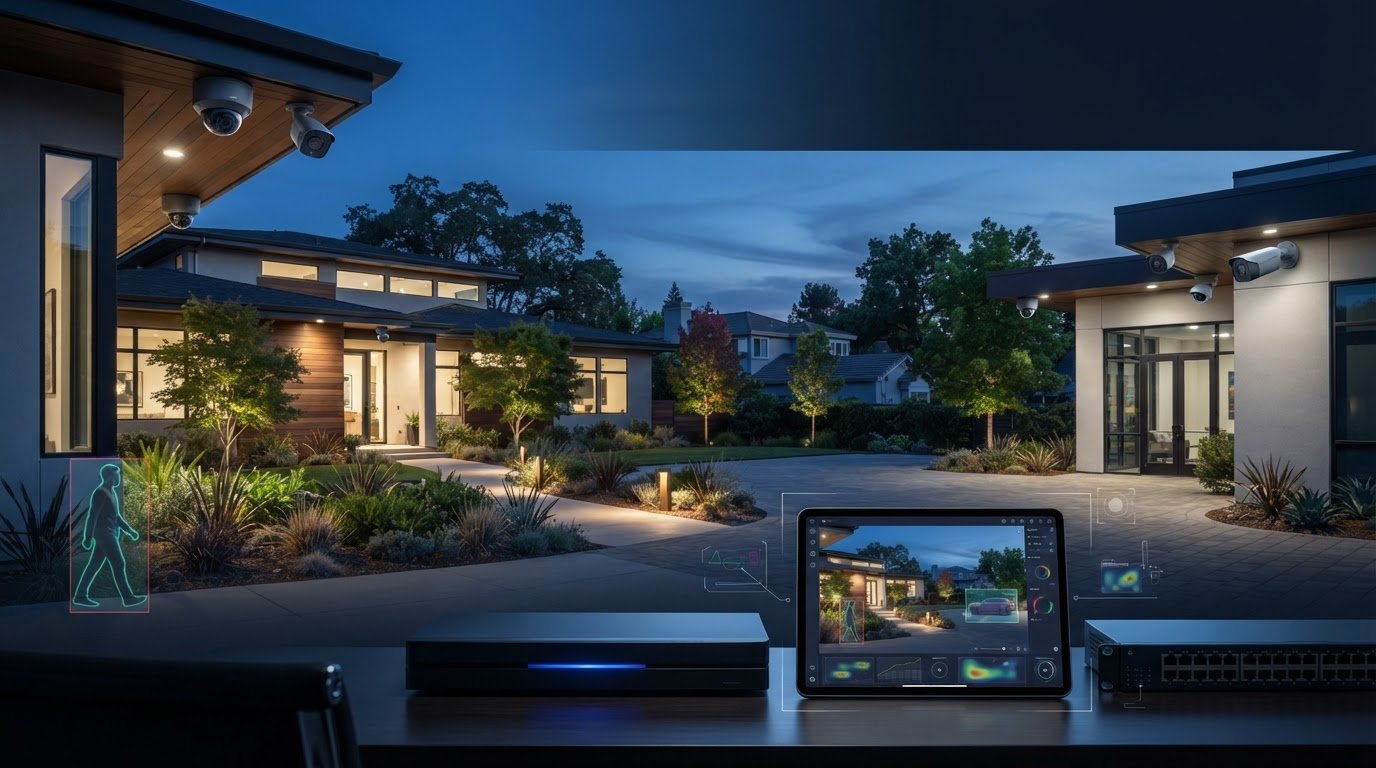
The consumer push toward wire-free convenience has left too many property owners with dead batteries, dropped Wi-Fi feeds, and missed footage. When unexpected activity occurs, a truly dependable security camera system must record instantly in crisp detail without hesitation or network buffering.
Whether you protect a family home in Rocklin or Folsom, or oversee commercial facilities in Roseville, Elk Grove, or Sacramento, you shouldn’t have to wrestle with unstable connections or tolerate unsightly exterior wiring. Reliable defense requires continuous high-definition oversight alongside clean architectural aesthetics, ensuring no messy visible wires or conduits compromise your property’s exterior.
In this guide, you’ll discover how 4K PoE architecture, on-camera AI detection, and dedicated local NVR configurations deliver seamless protection and instant mobile alerts. We examine the core hardware components modern properties require, practical placement strategies to eliminate blind spots, and the structural standards that ensure long-term stability.
Key Takeaways
- Discover why an integrated 4K PoE security camera system outperforms consumer wireless gadgets by delivering uninterrupted data throughput, zero latency, and continuous local recording.
- Learn how edge-computing AI distinguishes between people, vehicles, and environmental movement, filtering out nuisance alerts while enabling proactive perimeter defense.
- Explore how dedicated NVR architecture keeps high-resolution video accessible without recurring cloud subscription fees, all while maintaining seamless mobile app access.
- Understand how strategic layout planning across Greater Sacramento properties eliminates blind spots and protects building envelopes with no messy visible wires or conduits.
The Evolution of the Modern Security Camera System in 2026
A modern security camera system is no longer just a collection of standalone lenses passively saving video to a digital vault. True surveillance today acts as an active, preventative perimeter shield. Rather than reviewing blurry footage after an intrusion has already occurred, contemporary systems detect, classify, and deter threats the moment they cross property boundaries.
This operational shift relies on converging high-resolution optical hardware with onboard neural processing units (NPUs). Instead of relying on central servers to analyze frames, intelligent cameras process visual inputs right at the network edge. For residential estates in Folsom and commercial logistics hubs across Sacramento, this unified network infrastructure provides immediate situational awareness without latency bottlenecks.
From Grainy CCTV to Ultra-High-Definition Surveillance
Surveillance has completely outgrown legacy closed-circuit television (CCTV) architecture, which depended on analog coaxial cabling and low-resolution analog sensors. Coaxial setups suffered from heavy signal degradation over long distances, high vulnerability to electrical interference, and unreadable pixelation when zooming in on critical details.
Digital IP infrastructure completely removes these limitations. True 4K resolution provides four times the pixel density of standard 1080p video, making it indispensable for evidentiary identification. In practical scenarios, this added fidelity reveals key details:
- Crisp License Plate Recognition: Accurately reads moving vehicle tags across entry gates and driveways.
- Definitive Facial Features: Isolates subtle facial characteristics even under high-contrast or back-lit lighting conditions.
- High-Resolution Digital Zoom: Preserves subject clarity during post-event forensic investigations without blurring into digital noise.
Intelligent Ecosystem Integration and Remote Management
Raw pixel count means little without intelligent management software. High-performance Network Video Recorders (NVRs) now consolidate multiple live streams into unified viewing dashboards, replacing chaotic multi-app monitoring. These recorders integrate directly with local network protocols, keeping video traffic stable and secure.
Edge AI algorithms distinguish between human movement, vehicles, passing pets, and wind-blown foliage. Real-time push alerts trigger only when genuine human activity enters defined zones. Through secure mobile app integration, property managers in Roseville and homeowners in Elk Grove can view synchronized multi-camera feeds, adjust intrusion boundaries, and manage recordings directly from their smartphones, maintaining constant visual control over their properties.
Core System Architecture: 4K PoE vs. Wireless Battery Setups
Wireless DIY cameras promise effortless setup, yet real-world conditions quickly expose their structural limits. Thick stucco, brick walls, and Sacramento summer temperatures exceeding 100 degrees degrade Wi-Fi signals and strain lithium batteries. In contrast, a hardwired security camera system backed by Power over Ethernet (PoE) ensures continuous, uninterrupted throughput regardless of environmental conditions.
Physical network lines provide dedicated bandwidth that wireless bands cannot replicate. While consumer battery gadgets sleep until triggered, often missing the opening seconds of an incident, physical cabling supports constant surveillance recording. For detailed network specifications, consult this thorough guide on PoE camera installation.
Why Power over Ethernet Delivers Uncompromising Performance
PoE simplifies low-voltage infrastructure by transmitting both electric power and high-speed network traffic through a single Cat6 Ethernet cable. This unified architecture delivers concrete functional benefits:
- Consistent Signal Integrity: Dedicated twisted-pair lines deliver zero-latency 24/7 video recording without packet loss, as detailed in our analysis of ethernet powered CCTV.
- Signal Jamming Immunity: Hardwired connections remain impervious to cheap de-authentication handhelds that knock consumer Wi-Fi devices offline.
- Aesthetic Concealment: Professional routing through attics and soffits leaves no messy visible wires or conduits across your exterior walls.
Dedicated NVR Storage Versus Cloud Subscription Traps
Consumer systems routinely lock high-resolution playback behind monthly subscription paywalls, restricting bitrates to lower server hosting overhead. A commercial-grade Network Video Recorder (NVR) solves this problem by using dedicated internal surveillance hard drives capable of storing terabytes of uncompressed 4K footage locally.
Local NVR storage also maintains privacy. Aligning with recommended FTC guidelines for securing security cameras, keeping your video archive on an isolated internal drive prevents third-party data exposures and outbound cloud bandwidth bottlenecks. Property owners across Rocklin, Roseville, and Folsom avoid perpetual monthly fees while retaining instant access to high-bitrate video. When planning your property layout, partnering with the low-voltage experts at StaySafe365 ensures your storage architecture matches your retention needs.
Next-Generation Surveillance Trends Reshaping Property Protection
Surveillance engineering has shifted toward proactive threat interception. A contemporary security camera system no longer functions as a passive digital observer. Instead, modern hardware evaluates threats in real time, executing automated countermeasures at the boundary before intruders approach entryways or loading docks.
Much of this capability stems from federal and industrial advancements in video analytics and artificial intelligence. By running lightweight deep-learning models directly on camera silicon, property managers throughout Sacramento and Elk Grove can deploy active deterrence protocols that operate independently around the clock.
AI-Powered Smart Motion and Object Detection
Legacy systems relied on simple pixel alteration to detect movement, triggering notifications whenever tree branches swayed or headlights washed across a driveway. Modern edge-AI vision engines evaluate spatial geometry and kinematic profiles, eliminating up to 90% of false alarms.
- Target Classification: Distinguishes humans, vehicles, and wildlife to ensure notifications represent real events.
- Virtual Tripwires: Triggers notifications only when an object crosses a defined vector, protecting driveway approaches and rear service alleys.
- Loitering Detection: Alerts security personnel when individuals remain stationary in sensitive zones beyond a set time threshold.
Full-Color Night Vision and Dynamic Sensor Tech
Infrared night vision often turns footage into washed-out, monochrome recordings where clothing colors and vehicle finishes become indistinguishable. Modern 4K optics counter this using large f/1.0 apertures paired with advanced back-illuminated sensors, pulling vibrant color from minimal ambient light.
High Dynamic Range (HDR) processing balances harsh vehicle headlights against deep perimeter shadows. When uninvited visitors breach restricted zones, integrated active deterrence cameras illuminate bright white LED spotlights while broadcasting localized audio warnings, turning passive monitoring into immediate intervention.
Local Network Security and Data Encryption Standards
Robust physical security requires equally resilient digital defenses. Professional surveillance installations isolate camera feeds onto dedicated Virtual Local Area Networks (VLANs), separating video traffic entirely from guest Wi-Fi and office computing systems.
This isolation prevents compromised smart devices from exposing security cameras. Transport Layer Security (TLS) and AES-256 encryption safeguard local recordings as well as authorized mobile streams accessed from Roseville or Rocklin. Routine, verified firmware management maintains hardware defenses, ensuring long-term system stability without exposing local networks to unauthorized external access.

Planning an Effective Surveillance Blueprint for Your Property
Every property presents distinct architectural blind spots and structural challenges. Mounting cameras arbitrarily without a strategic layout creates coverage gaps and a false sense of protection. A dependable security camera system requires a methodical perimeter audit that matches optical focal lengths to specific physical sightlines.
Effective property blueprints establish continuous visual custody. When a subject moves along an access route, their movement should register seamlessly across multiple camera fields of view without disappearing into unmonitored zones.
Strategic Perimeter and Access Point Mapping
Strategic layout design balances wide situational awareness with detailed subject identification at critical access choke points. Mounting units eight to ten feet above ground level keeps lenses safe from physical tampering while preserving the shallow viewing angles needed to capture clear facial profiles instead of the tops of heads.
Collaborating with seasoned home security camera installers helps coordinate these essential zones into an overlapping defense web:
- Entry Portals and Porches: Narrower focal lengths isolate doorways, capturing clean identification shots of visitors and package deliveries.
- Driveways and Vehicle Approaches: Calibrated optical angles record approaching vehicles clearly without blinding glare from headlights.
- Perimeter Fence Lines: Interlocking camera placements cover long property perimeters and side yards, ensuring zero blind spots along fence lines.
Adapting Systems for Greater Sacramento Environmental Factors
Surveillance hardware installed in Northern California must withstand demanding environmental conditions. Sacramento Valley summers regularly bring temperatures exceeding 100 degrees, turning unshaded south- and west-facing building eaves into severe thermal traps. Selecting industrial IP67 weather-rated metal housings prevents component degradation and stops processors from throttling during extreme heat.
Sun angles across Roseville, Rocklin, and Folsom also present intense afternoon glare. Shielded eave placements and hardware-level dynamic sensors prevent direct sunlight from washing out critical footage. Concealing cabling through interior attic spaces ensures no messy visible wires or conduits compromise your building’s architectural finish. To design an installation tailored to your specific property footprint, request a security project quote from StaySafe365.
Why Professional Installation Outperforms DIY Setups
Mounting cameras on exterior surfaces involves far more than fastening a bracket and syncing an app. Every wall penetration through stucco, wood siding, or commercial masonry risks compromising the building envelope. An improper drill path invites moisture intrusion, pest entry, and structural rot behind finished walls.
Professional deployment guarantees structural integrity while delivering uninterrupted 24/7 video uptime. Commercial facilities with loading bays, customer parking, or expansive multi-tenant suites face complex logistical requirements. For large-scale facilities, exploring dedicated commercial security camera installation in Sacramento ensures compliant low-voltage routing and complete perimeter oversight.
Aesthetic Excellence: No Messy Visible Wires or Conduits
Tacked exterior cables and surface-mounted conduit immediately undermine the architectural value of custom homes and clean commercial properties. Direct sunlight also degrades exposed jackets over time, causing premature cracking and signal loss.
- Concealed Pathways: Technicians route Cat6 lines internally through attic rafters, wall cavities, and soffits, ensuring no messy visible wires or conduits mar exterior facades.
- Watertight Seals: Precision-drilled entries receive industrial silicone seals and flush junction boxes, protecting wall interiors from heavy rainfall.
- Vibration-Proof Anchoring: Rigid mounting to solid framing prevents wind shake and picture drift during seasonal storms.
Precision Configuration and Greater Sacramento Expertise
Physical mounting represents only half the equation. Calibrating the central recorder demands deep network knowledge. Technicians configure custom motion masks to filter out busy public streets, adjust bitrates for efficient storage, and securely link mobile apps for instant remote viewing on phones and tablets.
Properties across Sacramento, Elk Grove, Rocklin, and Natomas benefit from surveillance customized to local architectural layouts and security demands. Whether you manage commercial facilities or want to upgrade your family residence, take the next step toward permanent peace of mind. Contact our local team today to schedule an on-site consultation or request a security project quote tailored to your property.
Secure Your Property with Long-Term Visual Defense
True perimeter defense requires more than off-the-shelf gadgets and fragile wireless connections. Investing in a hardwired 4K PoE security camera system guarantees continuous visual uptime, responsive edge-AI threat detection, and secure local NVR storage without recurring cloud subscription traps.
Whether you’re safeguarding an executive residence in Folsom or managing commercial facilities across Roseville, Rocklin, or Elk Grove, professional engineering makes all the difference. Meticulous internal cable routing preserves your building’s architectural finish, ensuring no messy visible wires or conduits compromise exterior aesthetics while keeping equipment resilient against scorching Sacramento Valley summers.
Take command of your perimeter with surveillance engineered for enduring reliability. Schedule an on-site consultation or request your custom security project quote today to build a surveillance network tailored precisely to your property’s needs.
Frequently Asked Questions
What is the difference between an NVR and a DVR security camera system?
An NVR (Network Video Recorder) processes digital IP camera video transmitted over network cables, whereas a DVR (Digital Video Recorder) converts analog signals delivered across coaxial lines. NVR systems support native 4K resolution, edge-AI analytics, and single-cable Power over Ethernet wiring. For residential and commercial properties across Sacramento, an NVR security camera system provides superior image detail, flexible placement, and reliable network performance.
Can a modern security camera system operate without an internet connection?
Yes, a hardwired NVR surveillance setup functions completely offline for continuous local recording, motion indexing, and live on-site monitoring. Cameras connect directly to the recorder over an isolated local network, storing encrypted footage on internal hard drives. An internet connection is only needed when you want to view live feeds remotely, receive smartphone notifications, or manage off-site backups while traveling away from home.
How many cameras do I need to cover an average residential home?
Most single-family properties in Roseville, Rocklin, or Folsom achieve balanced perimeter defense with four to six strategically positioned cameras. A four-camera layout reliably protects front entryways, driveway approaches, side access gates, and rear patios. Larger properties or homes with detached garages often benefit from six to eight cameras to eliminate blind spots along fence lines without creating redundant, overlapping coverage.
Why should I choose hardwired PoE cameras over wireless battery models?
Hardwired PoE cameras eliminate the constant hassle of battery swaps, signal dropouts, and recording latency. A single Ethernet cable delivers continuous electrical power and high-speed data transmission, keeping your security camera system recording 24/7 without interruption. Unlike battery-powered consumer devices that sleep to conserve energy, PoE hardware records continuously, ensuring you don’t miss the critical initial seconds of an event.
How does AI motion detection prevent false alerts from shadows and pets?
Edge-computing neural processors analyze physical dimensions, movement vectors, and structural contours rather than simple pixel changes. Instead of sending an alert every time tree branches sway or headlights sweep across the driveway, the camera’s algorithm identifies human outlines and vehicle profiles. Property owners across Elk Grove and Natomas receive actionable notifications only when an actual person or vehicle crosses a defined perimeter boundary.
Will installing outdoor cameras damage my home exterior or leave visible wires?
Professional installation preserves exterior integrity and guarantees no messy visible wires or conduits across your walls. Low-voltage technicians route Cat6 cabling internally through attic spaces, wall cavities, and soffits before mounting fixtures directly to framing. Exterior penetrations receive weatherproof silicone seals and flush-mounted junction boxes, preserving your home’s curb appeal while protecting against moisture intrusion and severe Sacramento summer heat.
How much video footage can a standard security system NVR store?
A dedicated NVR equipped with a standard surveillance-grade hard drive typically retains two to four weeks of continuous 4K footage across multiple channels. Total retention depends on drive capacity, camera count, and compression codecs like H.265, which cuts storage demands in half compared to older formats. You can also configure motion-based retention schedules to preserve critical incident video for several months.
Leave a Reply