

Did you know that 61% of U.S. households now have at least one security camera, yet many homeowners still feel vulnerable? It's a common paradox in Sacramento and beyond. You want to protect your family, but the sheer variety of cameras for security at home can feel overwhelming. It's natural to worry about blind spots or feel anxious about complex wiring that might fail when you need it most.
This guide will show you how to choose the right technology and place it strategically to gain total control over your environment. We'll explore the differences between high-definition 4K systems and smart wireless options, while identifying the exact locations that act as the ultimate deterrent. You don't have to settle for a DIY setup that leaves you guessing. By the end of this article, you'll understand how a professionally calibrated system provides the quiet confidence of a tech-forward guardian, keeping watch 24/7 so you don't have to.
Key Takeaways
- Learn how to differentiate between indoor and outdoor surveillance needs to build a robust security backbone for your property.
- Discover the "layers of protection" strategy to eliminate blind spots by strategically placing cameras for security at home across your perimeter and entry points.
- Evaluate the reliability of hardwired POE systems versus the flexibility of wireless options to maintain a constant, unwavering connection.
- Identify modern technical specifications, including full-color night vision, that ensure your footage provides clear and actionable oversight.
- Understand why professional calibration and installation in the Sacramento area provide a more reliable deterrent than standard DIY setups.
Choosing the Right Home Security Cameras in 2026
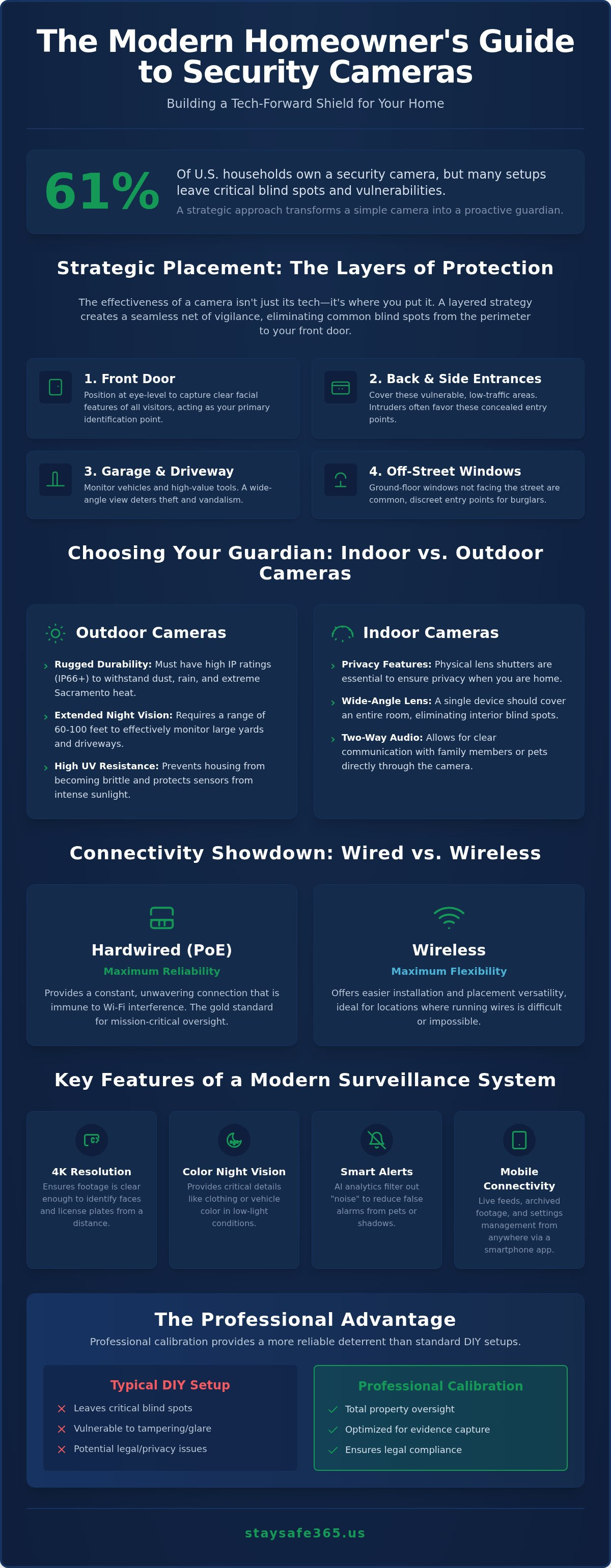
Modern residential protection relies on a solid foundation. In 2026, cameras for security at home are no longer optional accessories; they are the backbone of a secure household. We view these systems as a tech-forward guardian. This means your security works proactively, providing oversight before a breach occurs rather than just recording it after the fact. High-definition resolution is now the non-negotiable standard for any reliable system. If your footage can't clearly identify a face or a license plate at thirty feet, the system isn't fulfilling its primary purpose.
A sophisticated system provides the quiet confidence that comes from being well-prepared. It isn't about living in fear. It's about having absolute control over your environment. Whether you are at work in downtown Sacramento or enjoying dinner in Folsom, your surveillance system remains a constant, watchful presence. It stays unobtrusive until action is required, ensuring your peace of mind remains intact.
Indoor vs. Outdoor Camera Specifications
Outdoor units require rugged builds to withstand environmental stress. You should look for high IP ratings, typically IP66 or higher, to handle dust and heavy rain. Sacramento homeowners face a unique challenge: extreme heat and intense sunlight. Selecting equipment with high UV resistance prevents the housing from becoming brittle or the internal sensors from overheating during a Central Valley summer. Outdoor cameras also need extended night vision range, often covering sixty to one hundred feet, to monitor large yards and driveways effectively.
Indoor cameras prioritize different capabilities to suit a living environment. Privacy is the primary concern here. Many modern units include physical privacy shutters that block the lens when you're home. You also want a wide-angle lens to ensure one device can cover an entire room without leaving blind spots. Two-way audio is another essential feature, allowing you to check in with family members or pets through a clear, responsive connection.
Smart Integration and Mobile Connectivity
Connectivity transforms a simple recording device into a responsive safety tool. Mobile apps provide real-time oversight from any location. You can view live feeds, review archived footage, and manage settings directly from your smartphone. This seamless integration ensures you are always connected to your home's status.
Modern smart alerts are more sophisticated than ever. They use advanced analytics to filter out "noise" such as swaying trees, passing shadows, or roaming pets. This precision reduces the fatigue of false alarms and ensures you only receive notifications for genuine security events. Integrating these cameras with your existing home alarm system creates a unified defense. When your sensors and cameras work in tandem, they provide a comprehensive shield that is both efficient and reliable.
Strategic Placement: Where Your House Security Cameras Matter Most
Choosing the right hardware is only the first step. The true effectiveness of cameras for security at home depends entirely on where they are mounted. Even the most advanced 4K sensor fails to protect your property if it's blinded by glare or positioned in a way that leaves easy entry points unmonitored. We utilize a layers of protection strategy to ensure comprehensive oversight. This approach moves from the perimeter to the entry points and finally into the interior. It creates a seamless net of vigilance that eliminates the blind spots common in DIY setups.
Professional calibration accounts for variables that often escape the layperson. For instance, mounting a camera too high might provide a great view of the neighborhood but fails to capture a clear face under a baseball cap. Conversely, cameras placed too low are vulnerable to tampering. Legal considerations are equally vital. California law requires all-party consent for recording confidential communications, and federal law protects areas where neighbors have a reasonable expectation of privacy. Strategic placement ensures you stay within these boundaries while maintaining total control over your own space.
The Five Critical Exterior Mounting Points
- Front Door: Position this at eye level if possible. It captures delivery interactions and provides the best chance of identifying visitors clearly.
- Back and Side Entrances: These are often the most vulnerable spots. Intruders favor these areas because they offer more concealment than the front of the house.
- Garage and Driveway: Your vehicles and high-value equipment stored in the garage are frequent targets. A wide-angle view here acts as a significant deterrent.
- Yard Perimeters: Monitoring the edges of your property provides an early warning system. It allows you to respond to threats before they reach your actual dwelling.
Optimizing Interior Coverage for Peace of Mind
Interior cameras should focus on the central arteries of the home. Main hallways are high-traffic areas that anyone moving through the house must use. Placing cameras here allows you to track movement without placing devices in every single room. Common areas like living rooms provide oversight of unusual activity, but they should be positioned to respect the daily privacy of your family. Finally, monitoring the interior side of entry points serves as a critical backup. If an intruder manages to bypass exterior layers, this final camera captures the breach with clarity.
Professional calibration ensures your home remains a fortress without invading the privacy of others. You can explore expert security installation to find the perfect balance for your Sacramento property.
Wired vs. Wireless: Evaluating Connectivity and Reliability
Choosing how your cameras connect is a pivotal decision for long-term safety. While wireless options offer rapid deployment, they often introduce a reliability gap that physical cables simply don't have. For cameras for security at home to function as a true guardian, the connection must be unwavering. Wi-Fi signals can drop due to interference, distance, or even weather conditions; this leaves your property unmonitored at critical moments. Physical cables provide a dedicated, high-speed pathway that remains stable regardless of how many other devices are using your home network.
Hardwired systems, specifically those using Power over Ethernet (POE), eliminate these vulnerabilities. POE technology is both elegant and efficient. It carries high-speed data and electrical power through a single Ethernet line. This reduces the number of cables required and ensures that your cameras aren't dependent on the fluctuating strength of a wireless router. It's a professional-grade solution that provides the quiet confidence of knowing your surveillance is always active and always recording.
The Case for Wireless Flexibility
Wireless units serve a specific purpose in a comprehensive security plan. They are ideal for hard-to-reach locations where running a cable is physically impossible or prohibitively expensive. However, you must manage your Wi-Fi bandwidth carefully. A multi-camera wireless setup can easily saturate a home network, slowing down your internet speeds and causing lag in your security feed. There is also the maintenance reality to consider. Battery-powered units require regular charging or replacement. This becomes a tedious chore when cameras are mounted high on a ladder, leading to periods where the camera is offline and your home is exposed.
The Security Professional Choice: Hardwired Systems
Most experts consider hardwired POE systems the gold standard for residential surveillance. These systems support 24/7 continuous recording without the latency issues that plague consumer-grade wireless gadgets. When an event occurs, you receive a zero-latency alert, providing the immediate responsiveness needed to take action. Professional installation also solves the aesthetic problem. Instead of exposed DIY cords draped along your siding, an expert installer hides the wiring within walls and conduits. This creates a seamless, built-in look that enhances your home's curb appeal while keeping the infrastructure protected from the elements and potential tampering. Sacramento homeowners often choose this route to ensure their systems remain functional and unobtrusive for years to come.
Key Features of Modern Surveillance Systems
Reliable cameras for security at home are defined by technical specifications that translate directly into safety. It isn't enough to simply have a recording; you need actionable data. Modern systems have evolved beyond the grainy, black-and-white infrared footage of the past. Today's full-color low-light technology allows you to see vibrant details even in near-total darkness. This clarity is essential when reporting incidents to local Sacramento authorities, as it provides precise descriptions of clothing or vehicle colors that infrared sensors often miss.
Two-way audio serves as a powerful proactive tool rather than a passive observer. It allows you to communicate with delivery drivers or, more importantly, issue a direct warning to someone loitering on your property. This immediate interaction often stops a crime before it begins. When combined with the right storage solution, these features create a robust defense. While cloud-based subscriptions offer convenience, a local Network Video Recorder (NVR) provides superior data privacy and 24/7 recording without recurring monthly fees or reliance on an external internet connection.
Resolution and Field of View (FOV)
High resolution is a fundamental requirement for modern oversight. We recommend 2K or 4K resolution because it allows you to digitally zoom into a frame without losing the critical details of a face or a license plate. Retinal vision is the gold standard for clarity, representing the point where the camera's detail matches or exceeds the capabilities of the human eye at a specific distance. You must also balance the Field of View. A lens that's too wide can distort images and lose detail at the edges, while one that's too narrow might miss peripheral movement. A professionally calibrated FOV ensures your yard is covered without sacrificing the sharpness needed for identification.
Advanced Detection and AI Alerts
Intelligence is what separates a modern guardian from a simple sensor. Simple motion sensing often results in alert fatigue caused by swaying trees or passing cars on a Sacramento street. Intelligent person detection uses AI to distinguish between a human being and a neighborhood pet. You can further refine this by setting custom activity zones. These zones tell the camera to ignore the public sidewalk and only trigger an alert when someone enters your private driveway or porch. For active crime prevention, integrated sirens and spotlights can be programmed to activate automatically when a person is detected in a restricted zone, providing a clear signal that the property is under constant watch.
To ensure your system includes these essential safeguards, you can request professional security installation tailored to your home's unique layout.
Professional Installation: The StaySafe365 Advantage in Sacramento
Choosing the right equipment is a significant step toward safety, but the installation process determines whether those tools actually protect you. Many homeowners consider hiring a general handyman for the job. However, cameras for security at home require a level of technical precision that goes beyond basic mounting. A specialist understands the nuances of network security, signal optimization, and the critical importance of secure, weather-resistant connections. We act as your tech-forward guardian, ensuring that your system isn't just a collection of gadgets, but a unified defense that works when you need it most.
Our commitment to the Sacramento, Roseville, and Folsom communities is built on a foundation of reliability and integrity. We don't just drill holes and leave. Every project concludes with a meticulous calibration process. We test every angle to eliminate blind spots and verify that your motion zones are perfectly tuned. This final step ensures your peace of mind is absolute before our team leaves your property. You deserve a system that remains a constant, watchful presence without requiring constant troubleshooting.
Transparent Tiered Pricing for Every Home
We believe that professional security should be accessible and its costs should be transparent. We've eliminated the anxiety of opaque estimates by providing a clear, flat-rate tiered pricing model. This allows you to plan your budget with confidence, knowing exactly what the investment will be from the start. Our professional installation rates are structured to fit the specific needs of your property:
- Single Camera Installation: $90. This is an ideal entry point for front-door oversight.
- 2 Cameras: $150. Perfect for covering both the primary entrance and a driveway.
- 4 Cameras: $350. A comprehensive solution for most standard residential lots.
- 6 Cameras: $550. Provides extensive coverage for larger homes or those with multiple outbuildings.
- 8 Cameras: $650. Our most robust package for total property oversight.
Every tier includes professional mounting, expert wiring management, full system configuration, and mobile app setup. We ensure your cameras for security at home are fully integrated with your devices, giving you immediate control over your environment.
Expert Setup in the Sacramento Region
Local knowledge is a vital component of our service. We understand the specific architectural challenges common in Northern California homes, from the stucco siding of Elk Grove residences to the multi-story layouts in Rancho Cordova. Our team knows how to navigate these structures to hide wiring effectively and maintain the aesthetic integrity of your home. Moving from research to a fully protected environment is a seamless process with a partner who understands the local landscape. When you're ready to secure your property, a professionally calibrated system provides the quiet confidence that only true expertise can deliver.
Take Control of Your Home Security Today
Protecting your property requires more than just buying gadgets; it's about building a cohesive network of vigilance. You now understand that high-definition resolution and intelligent AI alerts are the baseline for modern safety. Strategic placement remains the most critical factor in deterring threats, while hardwired POE systems ensure your connection never falters during a crisis. By choosing the right cameras for security at home, you transition from a passive observer to a proactive guardian of your space.
StaySafe365 is ready to help you finalize this transition with expert precision. Our local specialists serve Roseville, Folsom, and Elk Grove, bringing advanced HD and POE expertise to every project. We eliminate the guesswork with transparent, flat-rate pricing starting at just $90 for a single camera, $350 for four cameras, or $650 for an eight-camera setup.
Get Professional Security Camera Installation in Sacramento Starting at $90
True peace of mind comes from knowing your system was installed by experts who value your safety as much as you do. Take the first step toward a more secure environment and enjoy the quiet confidence that comes from being well-prepared.
Frequently Asked Questions
Is it better to have wired or wireless cameras for security at home?
Hardwired POE systems are the superior choice for reliability and constant 24/7 recording. While wireless units offer easier placement in hard-to-reach areas, they are susceptible to Wi-Fi interference and battery failure. For cameras for security at home to function as a true guardian, a stable physical connection is essential. This ensures you never experience the latency or signal drops common with consumer-grade wireless gadgets, providing the quiet confidence of unwavering oversight.
How much does professional security camera installation cost in Sacramento?
Professional installation in the Sacramento region is accessible through our transparent, flat-rate pricing model. You can secure your property starting at $90 for a single camera. For more comprehensive coverage, we offer tiered packages such as four cameras for $350 or eight cameras for $650. This predictable structure eliminates the anxiety of hidden fees. Our experts handle everything from mounting and wiring to mobile app configuration in Roseville, Folsom, and surrounding areas.
Where is the best place to put outdoor security cameras?
Focus on the most vulnerable entry points to maximize your system's effectiveness. The front door, back entrance, and garage are the primary locations that require constant monitoring. You should also consider yard perimeters to create an early warning system. Mounting cameras approximately eight to ten feet high prevents tampering while maintaining a clear angle for facial identification. Professional calibration ensures your outdoor cameras for security at home cover every critical blind spot on the property.
Do security cameras need a monthly subscription to work?
No, a monthly subscription is not a technical requirement for all systems. While many cloud-based brands push recurring fees, local storage options like a Network Video Recorder (NVR) allow you to keep your footage on-site. This provides absolute control over your data without monthly costs. You'll still enjoy high-definition recording and real-time alerts. Choosing local storage is a proactive way to ensure your surveillance remains a constant, unobtrusive presence without ongoing financial commitments.
Can I see my home security cameras on my phone when I am away?
Yes, modern surveillance systems provide seamless mobile connectivity for real-time oversight. You can access live feeds, review archived footage, and manage settings directly from your smartphone. This integration ensures you remain connected to your home's status whether you're at work or traveling. Smart alerts filter out irrelevant movement, so you only receive notifications for genuine safety events. It's a tech-forward solution that puts absolute control of your environment in the palm of your hand.
How many cameras do I need for a standard three-bedroom house?
A standard three-bedroom house typically requires between four and six cameras for comprehensive coverage. This usually includes the front door, driveway, backyard, and side entrances. Our four-camera installation package for $350 is a popular choice for families in Sacramento neighborhoods. It creates a complete layers of protection strategy without over-complicating the setup. Larger properties or those with detached garages may benefit from our eight-camera package to ensure no blind spots remain unmonitored.
What happens to my security cameras if the power goes out?
Standard cameras will lose power during an outage unless you have a backup solution in place. We recommend connecting your NVR and POE switch to an Uninterruptible Power Supply (UPS). This ensures your system remains active during short power fluctuations or rolling blackouts. Maintaining vigilance during these times is critical, as power outages can sometimes be exploited. A well-prepared system continues its watchful presence, providing the stability and control you expect from a professional-grade security solution.
Are home security cameras legal to point at the street or neighbors?
It is legal to record public areas, such as the street or the space visible from your property. However, you must respect areas where neighbors have a reasonable expectation of privacy, such as their bedrooms or bathrooms. Pointing cameras directly into a neighbor's windows can lead to legal complications. California law is also very strict regarding audio recording, requiring all-party consent for confidential communications. Professional installers ensure your camera angles are calibrated to provide safety without violating privacy laws.


